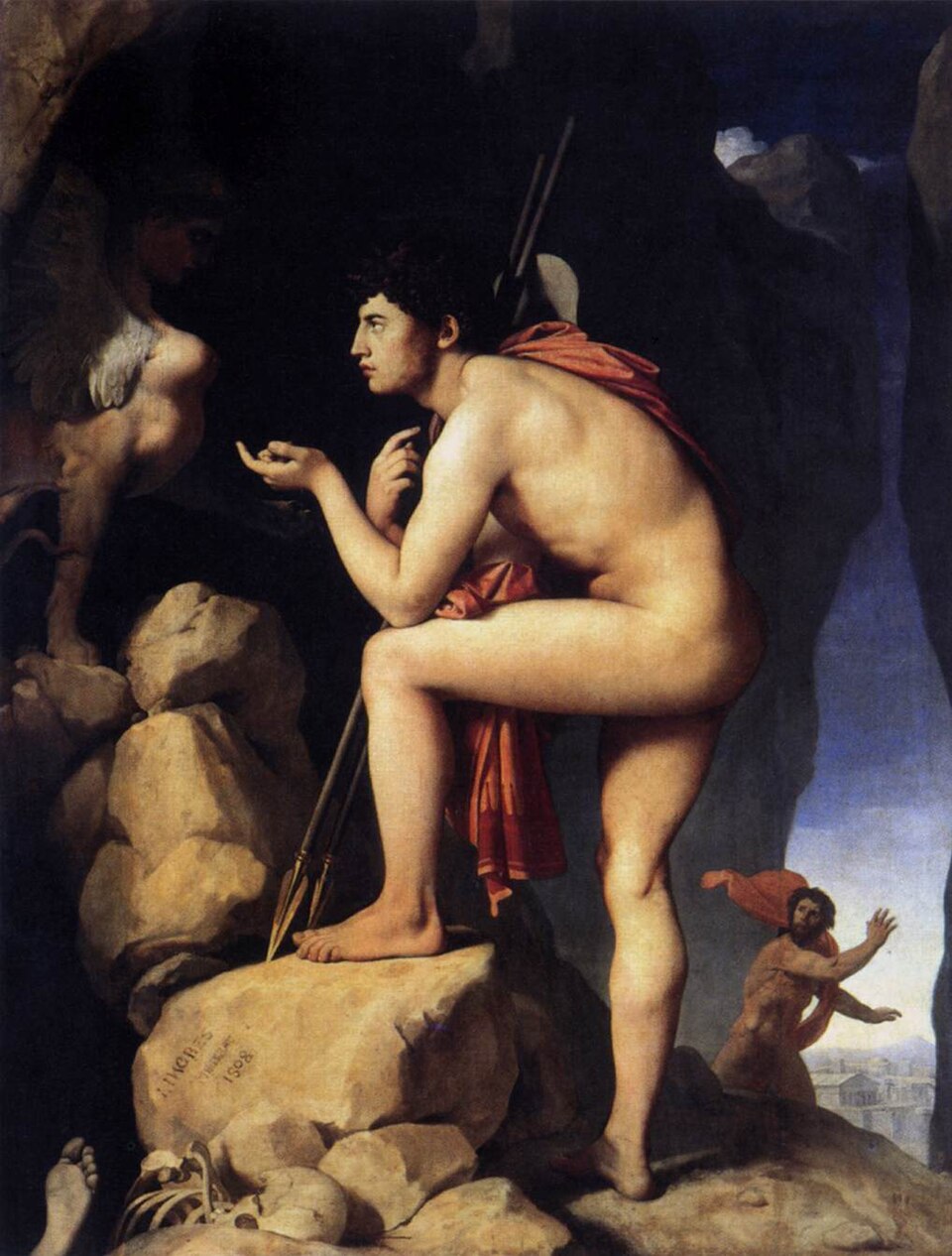
I refer to the legend of King Oedipus and the drama of the same name by Sophocles. Oedipus, the son of Laius, king of Thebes, and of Jocasta, is exposed while a suckling, because an oracle has informed the father that his son, who is still unborn, will be his murderer. He is rescued, and grows up as the king’s son at a foreign court, until, being uncertain about his origin, he also consults the oracle, and is advised to avoid his native place, for he is destined to become the murderer of his father and the husband of his mother. On the road leading away from his supposed home he meets King Laius and strikes him dead in a sudden quarrel. Then he comes to the gates of Thebes, where he solves the riddle of the Sphynx who is barring the way, and he is elected king by the Thebans in gratitude, and is presented with the hand of Jocasta. He reigns in peace and honour for a long time, and begets two sons and two daughters upon his unknown mother, until at last a plague breaks out which causes the Thebans to consult the oracle anew. Here Sophocles’ tragedy begins. The messengers bring the advice that the plague will stop as soon as the murderer of Laius is driven from the country. But where is he hidden?
“Where are they to be found? How shall we trace the perpetrators of so old a crime where no conjecture leads to discovery?”1
The action of the play now consists merely in a revelation, which is gradually completed and artfully delayed—resembling the work of a psychoanalysis—of the fact that Oedipus himself is the murderer of Laius, and the son of the dead man and of Jocasta. Oedipus, profoundly shocked at the monstrosities which he has unknowingly committed, blinds himself and leaves his native place. The oracle has been fulfilled.
The Oedipus Tyrannus is a so-called tragedy of fate; its tragic effect is said to be found in the opposition between the powerful will of the gods and the vain resistance of the human beings who are threatened with destruction; resignation to the will of God and confession of one’s own helplessness is the lesson which the deeply-moved spectator is to learn from the tragedy. Consequently modern authors have tried to obtain a similar tragic effect by embodying the same opposition in a story of their own invention. But spectators have sat unmoved while a curse or an oracular sentence has been fulfilled on blameless human beings in spite of all their struggles; later tragedies of fate have all remained without effect.
If the Oedipus Tyrannus is capable of moving modern men no less than it moved the contemporary Greeks, the explanation of this fact cannot lie merely in the assumption that the effect of the Greek tragedy is based upon the opposition between fate and human will, but is to be sought in the peculiar nature of the material by which the opposition is shown. There must be a voice within us which is prepared to recognise the compelling power of fate in Oedipus, while we justly condemn the situations occurring in Die Ahnfrau or in other tragedies of later date as arbitrary inventions. And there must be a factor corresponding to this inner voice in the story of King Oedipus. His fate moves us only for the reason that it might have been ours, for the oracle has put the same curse upon us before our birth as upon him. Perhaps we are all destined to direct our first sexual impulses towards our mothers, and our first hatred and violent washes towards our fathers; our dreams convince us of it. King Oedipus, who has struck his father Laius dead and has married his mother Jocasta, is nothing but the realised wish of our childhood. But more fortunate than he, we have since succeeded, unless we have become psychoneurotics, in withdrawing our sexual impulses from our mothers and in forgetting our jealousy of our fathers. We recoil from the person for whom this primitive wish has been fulfilled with all the force of the repression which these wishes have suffered within us. By his analysis, showing us the guilt of Oedipus, the poet urges us to recognise our own inner self, in which these impulses, even if suppressed, are still present. The comparison with which the chorus leaves us—
“... Behold! this Oedipus, who unravelled the famous riddle and who
was a man of eminent virtue; a man who trusted neither to popularity
nor to the fortune of his citizens; see how great a storm of adversity
hath at last overtaken him” (Act v. sc. 4).
This warning applies to ourselves and to our pride, to us, who have grown so wise and so powerful in our own estimation since the years of our childhood. Like Oedipus, we live in ignorance of the wishes that offend morality, wishes which nature has forced upon us, and after the revelation of which we want to avert every glance from the scenes of our childhood.
In the very text of Sophocles’ tragedy there is an unmistakable reference to the fact that the Oedipus legend originates in an extremely old dream material, which consists of the painful disturbance of the relation towards one’s parents by means of the first impulses of sexuality. Jocasta comforts Oedipus—who is not yet enlightened, but who has become worried on account of the oracle—by mentioning to him the dream which is dreamt by so many people, though she attaches no significance to it—
“For it hath already been the lot of many men in dreams to think
themselves partners of their mother’s bed. But he passes most easily
through life to whom these circumstances are trifles” (Act iv. sc. 3).
The dream of having sexual intercourse with one’s mother occurred at that time, as it does to-day, to many people, who tell it with indignation and astonishment. As may be understood, it is the key to the tragedy and the complement to the dream of the death of the father. The story of Oedipus is the reaction of the imagination to these two typical dreams, and just as the dream when occurring to an adult is experienced with feelings of resistance, so the legend must contain terror and self-chastisement. The appearance which it further assumes is the result of an uncomprehending secondary elaboration which tries to make it serve theological purposes (cf. the dream material of exhibitionism, p. 206). The attempt to reconcile divine omnipotence with human responsibility must, of course, fail with this material as with every other.2